


.webp)
Church Marketing
Church SEO for Pastors: Is your church invisible online?
Digital tools for churches are changing quickly, but becoming more tech savvy is not about chasing every trend. It is about learning to use technology wisely so your church can communicate clearly, reduce unnecessary work, and serve people more intentionally.


.webp)
Digital tools for churches are changing quickly, but becoming more tech savvy is not about chasing every trend. It is about learning to use technology wisely so your church can communicate clearly, reduce unnecessary work, and serve people more intentionally.
Artificial intelligence is no longer sitting on the edge of everyday work. It is shaping how teams write, analyze information, plan, automate tasks, and solve problems. For church leaders, that can feel exciting, overwhelming, or both.
AI is already becoming part of everyday ministry work. Barna found that 87% of U.S. pastors say they use AI. Half use it for brainstorming and idea generation, while 34% use it for administrative tasks like scheduling and emails.¹
But the goal is not to turn every pastor or ministry leader into a technology expert. It is to develop a posture that is curious, adaptable, and willing to keep learning.
As Carey Nieuwhof puts it, “The question for church leaders becomes not whether the church will embrace A.I., but how the church will embrace A.I.”²
.webp)
Churches do not need to know everything about every new platform. What matters is a willingness to keep learning, adapting, and evaluating technology through the lens of the mission by asking: Will this help us serve people better?
That mindset matters as communication habits and expectations continue to change. A learning posture helps your church stay responsive without chasing every new tool or holding onto outdated processes simply because they are familiar.
So what does that look like in practice? Here are five practical ways to start:
Using technology well is not about collecting apps or chasing every new feature. It is about choosing technology that helps your team serve your mission.
Carey Nieuwhof captures this well: “Embracing new methods always keeps the mission alive in ways that resisting them never will.”²
Many Christians see that potential. Barna found that a strong majority believe churches could benefit from digital tools, including a digital resource hub (74%), better social media outreach (70%), and digital communication strategies (68%).³
.webp)
The right tool should reduce friction, save time, improve clarity, or make a process stronger. So before adopting something new, ask:
Interested in digital communication? Explore 7 church marketing strategies that use digital tools to support your mission and fuel evangelism.
Pastors are already experimenting with AI in practical ways. Barna found that 50% use AI for brainstorming and idea generation, while 34% use it for administrative work like emails, scheduling, and document preparation.
One of the best ways to discover what AI can do is to experiment with it—take work you’re already doing and see what new ideas, formats, or approaches it can help you uncover.
Experiment with things like:
Every gain in clarity, speed, insight, and automation can become a gain in ministry impact when it is rightly directed.
.webp)
That is why using technology well is not separate from our values. It is one expression of stewardship. It is one way we honor people. It is one way we serve the Church with excellence in the modern age.
Colossians 3:23 says, "Whatever you do, work heartily, as for the Lord and not for men."
That includes how we build, how we improve, and how we steward the tools in our hands.
Technology can feel overwhelming when learning is treated like a major project. In practice, fluency often grows through small repetitions: one tutorial, one shortcut, one AI prompt pattern, or one feature explored at a time.
.webp)
Instead of telling your team, “We need to learn AI,” start with one real task.
The goal is not to master every new technology. Learn one useful thing, apply it to real ministry work, and build from there.
Visible learning is also a healthy behavior for leaders to model. You do not need to project perfection. Showing your team that you are open, engaged, and willing to improve gives others permission to learn as well.
God has not given us a spirit of fear, but of power, love, and a sound mind (2 Timothy 1:7).
Change does not have to be approached with fear. It can be met with steadiness, discernment, and a willingness to grow.
“An intelligent heart acquires knowledge, and the ear of the wise seeks knowledge.” — Proverbs 18:15
Curiosity is one of the clearest signs of a healthy technology culture. Curious leaders ask:

These questions become especially valuable when you apply them to the experience of someone outside your church.
Try searching for your own church the way a visitor would.
Open Google Maps and search “church near me.” Ask Siri or Alexa to find a church nearby.
Search for your denomination in your city. Then look at what someone sees.
Does your church show up in the top 5 results? Is your address consistent? Is it obvious where someone should go to learn more?
VisitorReach helps churches evaluate this kind of digital visibility and helps remove any barriers between someone searching and your church being found.
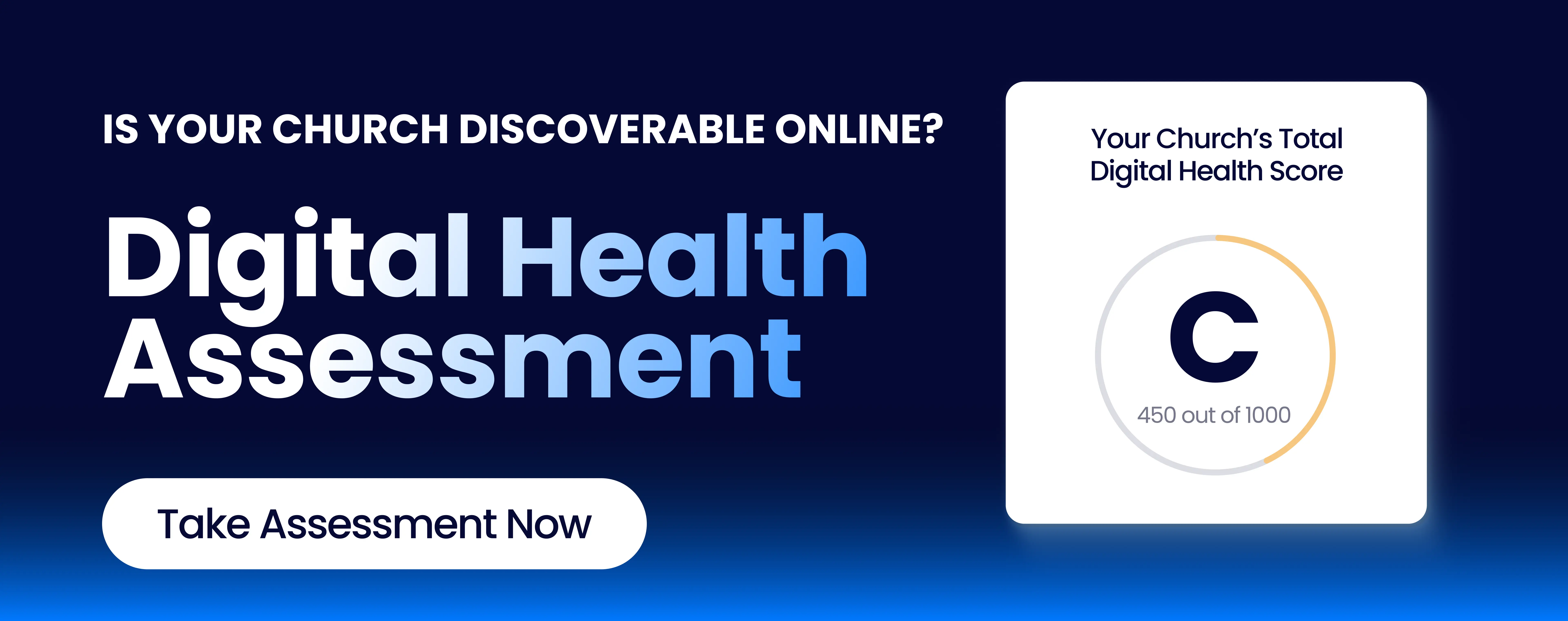
Want to quickly see how easy your church is to find online? Take the free Digital Health Assessment to find out!
Technology isn’t replacing ministry. Using new technology means choosing to stay useful, thoughtful, and ready in a world that keeps changing.
Churches need leaders who can combine wisdom with adaptability, conviction with curiosity, and mission with thoughtful execution.
VisitorReach brings digital outreach into one easy-to-use system, helping your church get found online, reach spiritually curious people, start conversations, and stay connected over time.
With the VisitorReach system, you get:
Technology cannot replace personal ministry, but it can help churches reach people searching for hope, connection, or a place to belong.
Ready to see what that could look like for your church? Book a 15-minute call today.
.webp)
Footnotes:
Create 100+ monthly connections with people in your area, have meaningful SMS conversations, and watch new visitors walk through your doors — All through the VisitorReach App!


.webp)
.webp)